
What Gilmer County Deed Records Convey
Deeds in Gilmer County start with the Gilmer Clerk of Superior Court. That office records warranty and quitclaim deeds, security deeds, liens, plats, surveys, covenants, UCC transactions, and related instruments. A deed documents a transfer placed in the public record. Its type signals the interest conveyed and the assurances the instrument purports to carry.
| Deed Type | What It Does | Common Use |
|---|---|---|
| Warranty deed | Conveys the stated estate with title covenants | Ordinary arm’s-length transfer |
| Quitclaim deed | Conveys whatever interest the signer holds | Family transfer or title cleanup |
| Security deed | Secures a debt against real estate | Financing rather than an ordinary sale |
| Executor or administrator deed | Conveys through estate authority | Probate-related transfer |
| Tax deed | Records a tax-sale purchaser’s interest | Delinquent-tax proceeding subject to redemption |
A deed and an encumbrance are different animals. The deed transfers an interest. A security deed, lien, easement, covenant, or release can burden, secure, limit, or clear it instead. So a useful deed search checks both categories under each party name.
Search Gilmer Instruments With the Real GSCCCA Fields
The GSCCCA Real Estate Index supports a focused deed-records search.
| Form control | How to use it | Caution |
|---|---|---|
| Party type | Choose grantor, grantee, or both | Reverse the role when walking backward |
| Last/company and first name | Enter the indexed spelling | Entities, initials, estates, and trusts vary |
| Instrument type | Narrow to deed, lien, plat, or release | Over-narrowing can hide related filings |
| County and dates | Select Gilmer and a sensible period | Modern coverage differs from historic books |
The official name-search capture shows these party, county, instrument, and date controls.
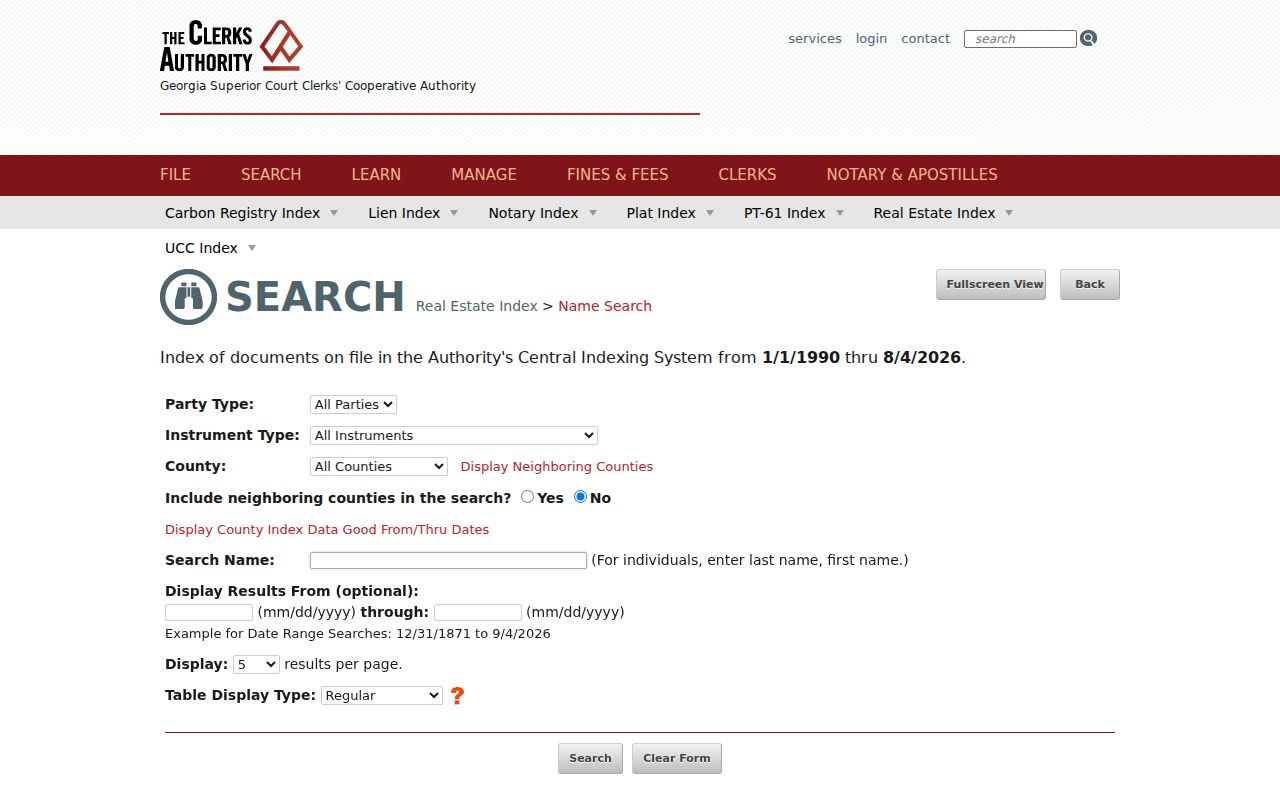
The role selector tells apart a person receiving property from that same person conveying it later.
The Gilmer Modern Index Has a Defined Horizon
GSCCCA describes a statewide transaction baseline of January 1, 1999, with 1993–1998 records being added. Gilmer's status page displayed records good through September 2, 2026. A good-through date shows indexing progress only. It does not promise that every older deed or image is online. The Gilmer status capture documents the cutoff.
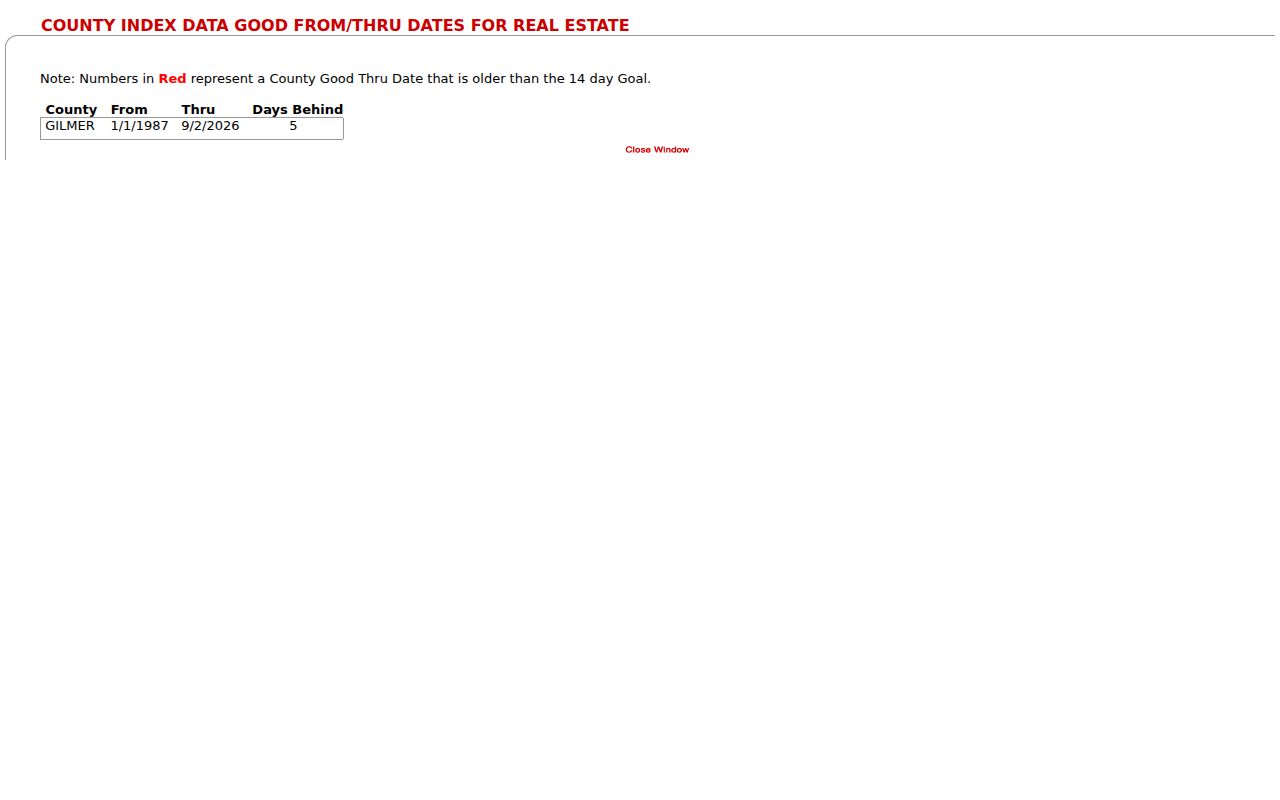
A closing scheduled near the displayed date deserves extra care. Confirm directly with the clerk. Absence from the results is not proof that an instrument went unrecorded.
Walk the Gilmer Grantor-Grantee Index Backward
Start with the newest reliable ownership deed. Read its grantor, grantee, legal description, execution and recording dates, and reference. Then take the prior owner's indexed name and locate how that owner acquired the same land, repeating the walk until the chain is complete.
- Find the current acquisition with the present owner listed as grantee.
- Compare the property description, land lot, acreage, and subdivision clues.
- Take the grantor and search that party as an earlier grantee.
- Repeat to the online boundary, then shift to books and microfilm.
- Grantor
- The party conveying the stated interest.
- Grantee
- The party receiving it.
- Chain of title
- The ordered sequence of instruments connecting ownership through time.
- Book/page or instrument number
- The clerk’s retrieval reference.
Gilmer Books A–R Reach Back to 1833
The Georgia Archives county microfilm catalog carries Gilmer deed and mortgage books from 1833. That is close to the county's 1832 organization. The verified run reaches through Book R in 1890. That is more than a century before the modern GSCCCA baseline. Archives material can be inspected through county microfilm resources. Current originals and certified copies stay with the Superior Court clerk. FamilyFamilySearch can serve as a finding aid. But citations should return to the actual volume and page.
The K–N Gap Is an Index Gap
Books K through N cover parts of 1851 to 1872. They carry a not-indexed marker on Gilmer County's Archives card. That matters for any property search of the era. A name lookup can come up empty. The deed itself sits safe in the book.
Work around the gap instead of giving up. Hunt through the book using whatever clues you hold. Try an approximate year, a party name, a land lot, a neighboring owner, a creek, or a tract's acreage. The point is simple. Discovery tools and surviving records are two different things. The older deed records often outlast the index built to find them.
One caution applies here. Keep the early wording intact. Resist forcing a nineteenth-century land-lot description into a modern street-address frame.
Use Book and Page to Bypass a Name Problem
A book and page citation can rescue a stalled deed search. When a tax card, a later deed, or a court filing hands you that reference, the GSCCCA Book/Page Search takes you straight to the instrument. Enter county, book, and page. Initials and punctuation stop mattering.
The official book/page search page shows the direct route in plain form.
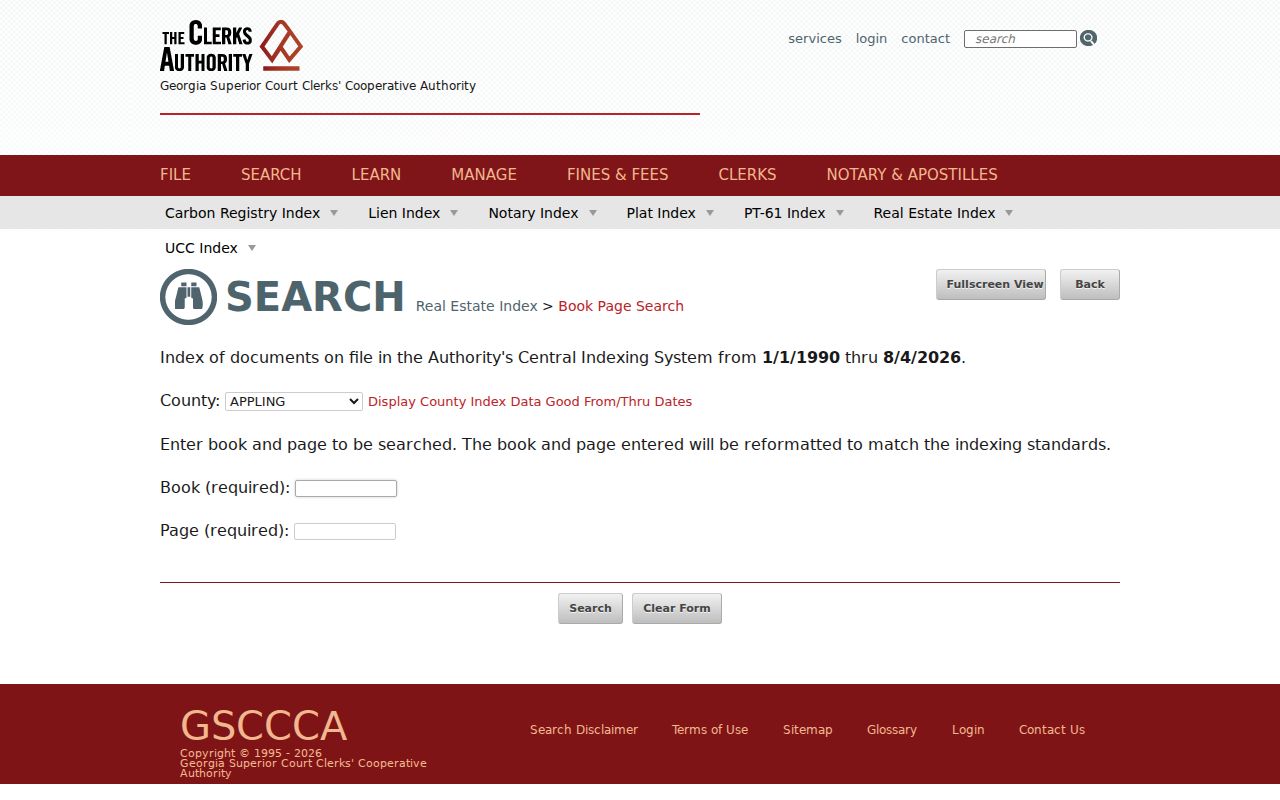
Even a surprising old spelling of a party's name loses its sting. The citation itself retrieves the deed.
Monitor Georgia Filings With FANS
Georgia title-theft safeguards changed January 1, 2025. The Attorney General directs owners to the GSCCCA Filing Activity Notification System, which alerts a subscriber when selected names appear in new filings. An alert reports activity; it does not decide whether a deed is genuine.
If an unfamiliar instrument appears, compare it with the known transaction trail and contact the clerk at the published 706-635-4462 number. Preserve the filing and seek appropriate professional or law-enforcement help.
Obtain a Gilmer County Deed Copy
An online image works fine when you only need an unofficial reference. For an authoritative copy, go through Clerk Amy E. Johnson. Her office sits at 1 Broad Street, Suite 203, Ellijay, GA 30540, and the phone number is 706-635-4462. Have the details ready: party names, instrument type, recording date, and the book and page or instrument number. Ask about current charges as well, since plain copies, certification, mailing, and images are each priced separately by the clerk.
If the online route stalls, use the counter or a mail request. Older deeds may live on Archives microfilm, so find that reference first and cite its book and page. A focused Gilmer open-records request also works. Under that route the county charges 10 cents per general copy, bills research time past 15 minutes, and allows at least three business days.
Recorded, not guaranteed. The index reports filed instruments, not a legal opinion on priority or clear title; unrecorded interests and defects may require professional examination.
Counter service makes sense for a few special cases. That includes a filing that appears in the index but has no accessible image, an oversized plat that loses detail online, or a certification required for a formal transaction. State the format you want. An index printout only identifies a filing. A plain copy reproduces it, while a certified copy bears the clerk's authentication, so the three products are not interchangeable.
Read the Deed Beside Its Related Instruments
A warranty deed often looks like the whole story. It is not. Gilmer County deed records work best when a warranty deed sits beside its security deeds, assignments, cancellations, easements, covenants, plats, and tax fifas filed under the same parties. Execution and recording dates can land far apart, so capture each instrument's exact type instead of labeling every land filing a plain deed.
Subdivision parcels demand a three-way check. Match the phase, the lot, and the plat reference across every instrument in the chain. Names like High River, Falling Waters, Laurel Ridge, The Vineyard at Yukon, and The Highlands at East Ellijay show up in official assessment descriptions, yet a subdivision name alone proves nothing about city limits or phase lines. The plat reference and the legal description settle the match.
Rural acreage is different. Preserve the land district, land lot, watercourse, road, and adjoining-owner calls, because those calls often bridge an early volume to a current qPublic parcel when no modern situs address existed at signing.
Estate Transfers May Need the Probate File Too
An estate can break a chain that first appears clean. When an executor, administrator, estate, or heir name appears where a buyer should be, the paper trail splits. Gilmer Probate Court in Suite 204 holds the wills and estates. The Superior Court clerk records the ownership instrument itself. Read the probate authority and the executor deed together whenever a death sits inside the chain of title.
Older routes exist too. FamilySearch catalogs Gilmer probate vouchers covering 1851 through 1911. The Georgia Archives holds microfilm routes for still older county material. Both explain authority or family relationships, but neither substitutes for the recorded conveyance. Restricted vital records carry their own eligibility rules. A deed researcher should request only what documents the transfer.
Distinguish Execution, Recording, and Index Dates
One deed can carry three different dates. It is signed on one, delivered in the transaction on another, and recorded later still. The GSCCCA good-through date tracks the progress of the public index. It does not mark when the underlying agreements arose. Label each date for what it is. Never build a chain purely from the order a search screen happens to display.
The legal description is the stronger parcel check. Compare land district and lot across consecutive instruments. Check subdivision and phase, lot or tract number, acreage calls, and plat reference too. A small wording shift may signal a partial conveyance or a parcel combination. It may mark a reserved easement. It could also be a correction deed rather than an ordinary resale of the whole parcel.
Book/page and instrument numbers are retrieval keys, not statements of legal effect. Read the actual instrument and any exhibit it references. An index entry may abbreviate a party or document type. A clerk copy resolves what the screen leaves vague.
Plats and Easements Complete the Gilmer Deed Picture
Plats and surveys live with the Clerk of Superior Court too. On subdivision land, the deed may simply incorporate a recorded plat. It does not restate every bearing and distance. Pull that plat. It shows the recorded lot, road, common area, and easement layout. qPublic then serves for orientation only.
Access rights matter in Gilmer's mountain terrain. Private roads, creek crossings, and ridge routes often surface only in recorded descriptions. So search the parties for easements, releases, covenants, and corrective filings. A visible driveway does not establish a recorded right of access. A mapped parcel shape does not either.
For a true boundary question, order the relevant instruments and consult a licensed surveyor. The tax GIS operates expressly as a reference map. It cannot fix an ambiguous deed description. It cannot stand in for a recorded survey.