
Trace Former Gilmer County Owners by Record Era
Pick the source that matches the period. The GSCCCA index opens the modern reverse chain, while the Georgia Archives holds the verified nineteenth-century deed and mortgage run for Gilmer County.
| Source | Years It Covers | Where Held | What It Shows |
|---|---|---|---|
| GSCCCA Real Estate Index | Statewide baseline from 1999; 1993-1998 being added | Online and Superior Court Clerk | Grantor, grantee, instrument, date, book/page |
| Gilmer deed/mortgage Books A-R | Verified excerpt, 1833-1890 | Georgia Archives microfilm; originals with Clerk | Earlier conveyances and mortgages |
| Recorded plats and surveys | Depth not stated | Clerk and GSCCCA Plat Index | Lot, block, phase, roads, and boundaries |
| Tax digests | Gilmer in 1787-1900 collection; county copies about 1872 forward | Archives and FamilySearch | Historical taxpayer, district, lot, acreage, and value clues |
Start with a modern owner online, then carry that book and page back into the older deed books at the Gilmer County recorder. A tax digest or plat can bridge a gap in the chain. Still, a name alone proves no conveyance.
Start the Gilmer County Backward Timeline Online
The Gilmer index status page publishes a rolling checkpoint, data through September 2, 2026. Treat that date as a measure of index currency. It is not a promise that every document image is viewable. GSCCAA describes statewide real-estate transactions from January 1, 1999. Records from 1993 through 1998 are being added over time.
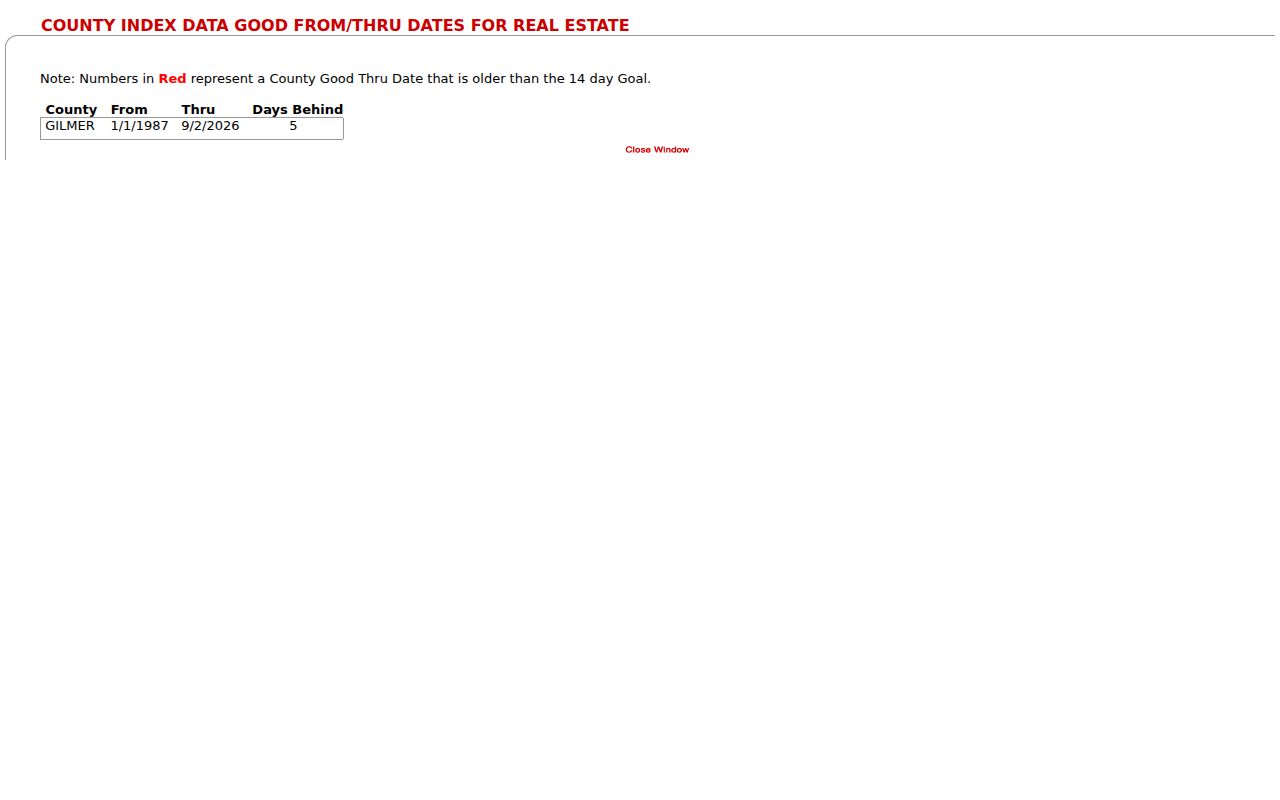
Use the published checkpoint to judge how current the deed index is. It tells you nothing about the date of any single transfer.
| Transfer date | Grantor to grantee | Deed type | Book/page |
|---|---|---|---|
| Newest matching record | Prior owner to current owner | Read the indexed instrument | Copy exactly |
| Next earlier acquisition | Earlier owner to prior owner | Confirm it conveyed this land | Carry back |
| Repeat | Each grantor becomes the next grantee search | Keep the description fixed | Build the citation chain |
Treat your work as a research worksheet rather than a finished title chain. If the index is silent on a gap, leave the gap open. Never invent a transfer the deed records do not show.
Work Through Gilmer County's Unindexed Books K-N
The Archives card is unusually detailed. Books A-B open in 1833. Indexed volumes C-J run through 1851. Then the trouble starts. Books K-L, covering 1851-1856, and M-N, covering 1856-1872, are marked not indexed. Indexed volumes O-R reach 1890.
A failed name search in the K-N span proves nothing. Browse the volume by date. Or pull a later deed's recital of the earlier book and page. The card continues past 1890, so recording clearly went on.
Online cutoff. The modern index has a 1999 statewide baseline. Older former owners require deed books or microfilm, and the 1851-1872 volumes need special care because they were not indexed.
Reach Gilmer County Former Owners Offline
For a certified copy or instrument image, contact Clerk Amy E. Johnson at 1 Broad Street, Suite 203, Ellijay, or call 706-635-4462. Give staff the book and page or instrument reference. The county publishes no current copy and certification fee. Ask for the cost when you order.
The Georgia Archives county microfilm catalog serves as the historical finding aid. On-site microfilm scans to a personal flash drive are free. Prints run 30 cents per page. FamilySearch also helps. A free account opens its catalog and Georgia collections. Images may be online, center-only, or restricted.
Note: Cite the collection title, date, and Archives cite-as field so another researcher can reproduce an early ownership link.
Reconstruct Gilmer County's Deed Chain Backward
The GSCCCA name form lets you pick Grantor or Grantee, instrument type, GILMER, and a date range. Start with the current owner's acquisition. Then reverse the roles one transfer at a time. The official name-search screen displays the party-role and date controls that drive this backward walk.
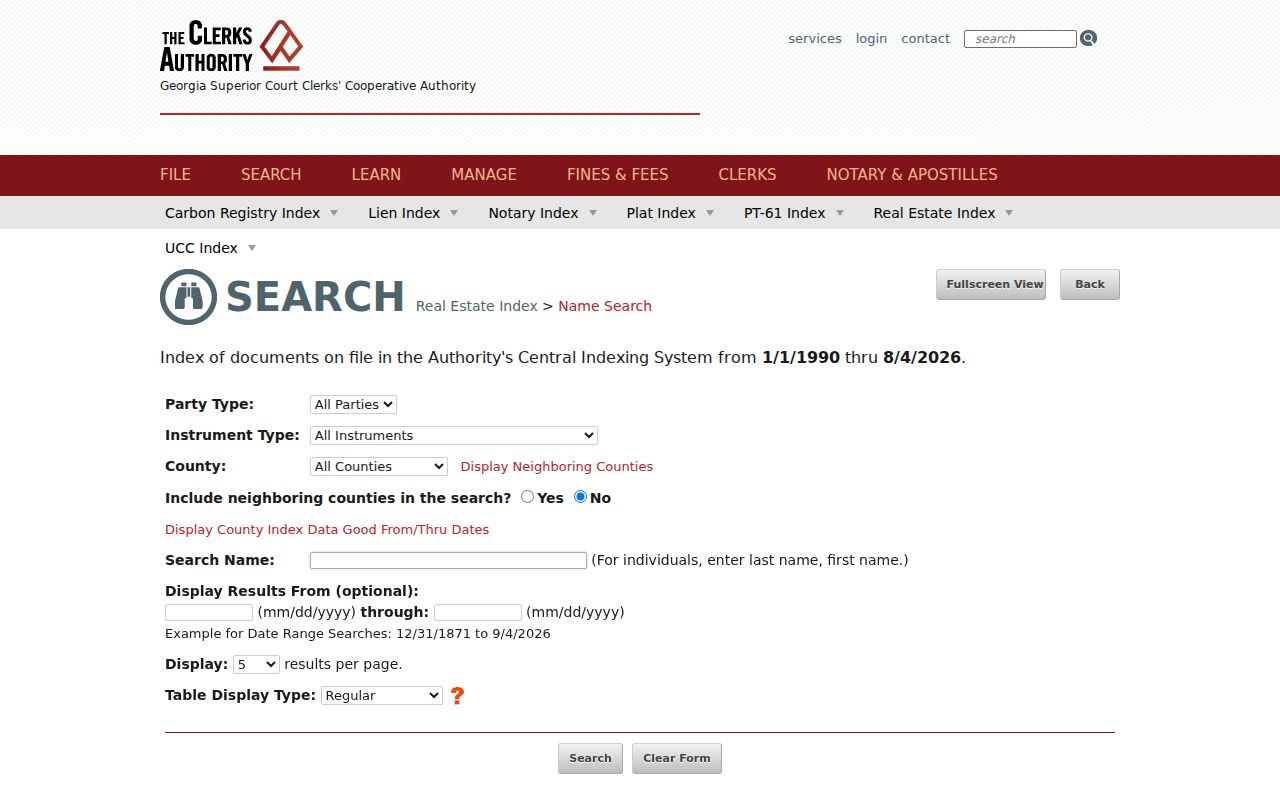
Set the role deliberately at every step. The same name as grantor points forward in time, while that name as grantee points to an earlier acquisition.
- Find the current owner as grantee and select the newest acquisition matching the parcel.
- Read the grantor, book/page, instrument type, and complete legal description.
- Search that grantor as a grantee to find how the prior owner acquired the same land.
- Repeat until the online coverage ends, then follow book/page references in microfilm.
- Grantor / grantee
- The conveying party and receiving party in an instrument.
- Chain of title
- The ordered sequence of conveyances affecting the same land.
- Reverse index
- The grantee-side path used to find acquisitions.
- Quitclaim / warranty deed
- Different deed forms whose effect must be read from the instrument.
Older deeds often cite a volume and page rather than a name. The GSCCCA book and page search takes that citation straight to the recorded instrument, making it the cleanest route into Gilmer County property records.
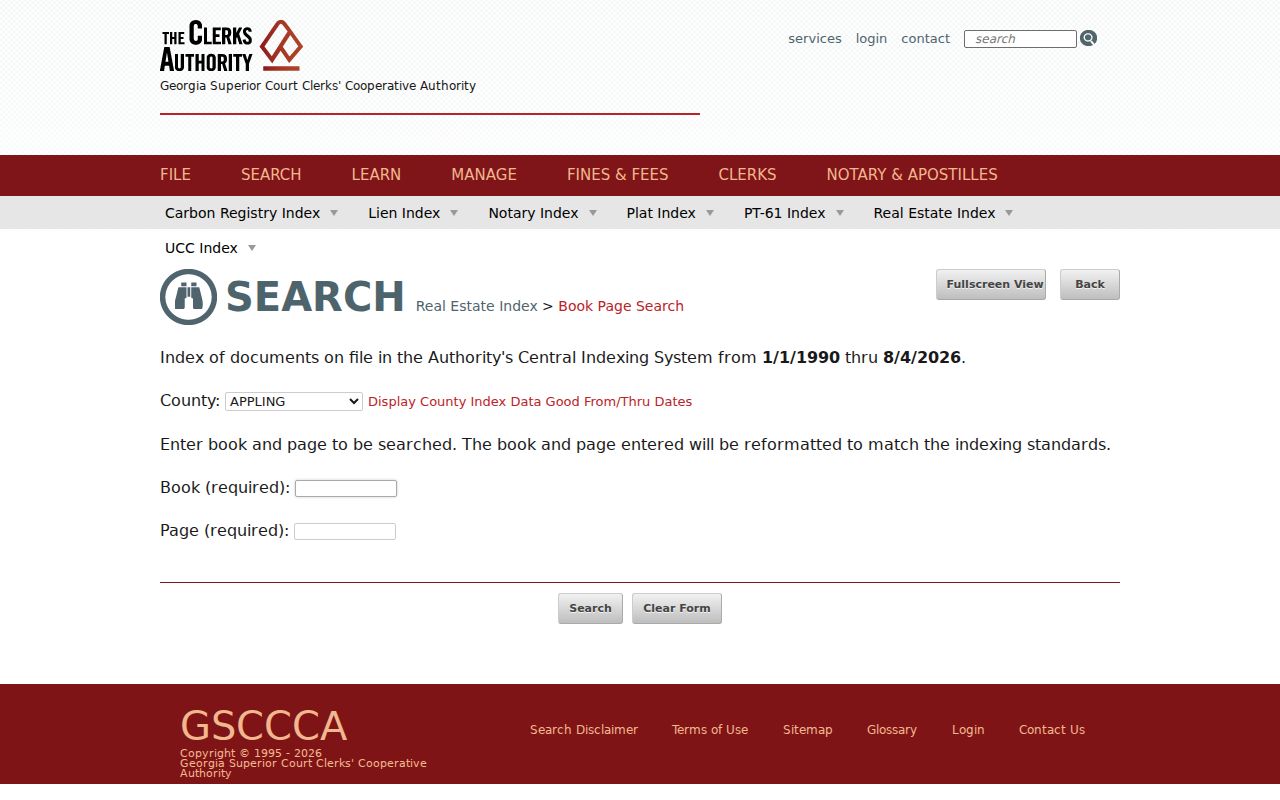
That citation beats a name-only guess. It locks onto one recorded spot in the deed records, though you still have to confirm the land description matches before trusting the chain.
Hold the Gilmer County Land Description Steady
An old deed may predate any current road address. Instead, compare the land district, land lot, metes-and-bounds calls, acreage, adjoining owners, and any subdivision, phase, lot, and block named in the deed records. Modern local descriptions show the same care: HIGH RIVER phases or letter-suffixed parcel numbers can turn on a single character. A wrong digit points to someone else's land entirely. Recorded plats help too. They clarify lot relationships, rights-of-way, easements, and common areas, and they fill gaps in a backward owner trail, but a plat never substitutes for the deed itself. City street or ZIP changes work the same way. They describe location and jurisdiction, not a change in who holds title.
Bridge Gilmer County Estate Transfers
A clean buyer-seller chain can snap when an owner dies. Gilmer County Probate Court holds the records that repair the break. These include the will, the petition, the inventory, the appointment of an administrator or executor, and any order authorizing a sale. Once the estate papers establish authority, return to GSCCCA deed records for Estate Documentation, a Deed From Estate, or a deed to heirs. Any other recorded transfer carrying a new owner of record onto the parcel belongs there too. Older probate material runs deep. Wills, returns, accounts, inventories, and appraisements document nineteenth- and early twentieth-century estates. Probate vouchers span 1851 to 1911. These papers can name prior owners and heirs clearly. The transfer still stands or falls on one test. The deed description must match the parcel.
Test Each Gilmer County Former-Owner Link
A chain worksheet earns its keep only if it captures more. Do not settle for a pair of names. Each Gilmer County transfer deserves its own line. Record the recording date, grantor, grantee, deed type, book and page, acreage, land district, land lot, subdivision lot, and any prior deed recited in the text. A prior-reference clause can carry you across a weak index. Still inspect the cited page yourself before trusting it.
Partial interests deserve special suspicion. A quitclaim, mineral deed, timber deed, right-of-way, boundary agreement, or trustee's deed may not be an ordinary sale. It may not cover the whole parcel. Joint owners sometimes convey years apart. The granting language and the property description decide whether someone truly belongs in the chain. Treat the main former-owner chain of the parcel accordingly.
Neighbor records fill gaps the deed books leave open. Tax digests can pin a name to a district during a missing interval. Plats show when a tract was first cut into lots. Probate files can explain an estate transfer. Yet none of these replaces the recorded deed sequence. So mark every inferred connection as a lead until an instrument or court order backs it up.
This discipline matters most in the 1851-1872 unindexed span of Gilmer County property records. Browsing is slower than a name search. It prevents a missing index entry from becoming an invented break in ownership. Keep citations even for pages that rule out a tempting same-name match.
Know How Far Gilmer County Former-Owner Records Go
Gilmer County dates to 1832, and its verified deed and mortgage run starts in 1833. The accessible Archives excerpt covers Books A-R through 1890. It notes that the records continue beyond that point. That excerpt boundary is not a records-loss claim. Earlier land history in Gilmer County may rest on state grants and parent-county context. It may also draw on tax digests and other archival evidence instead of the deed books.
Research limit. A reconstructed list of previous owners is not a certified title search. Use these records for lawful property history, estate work, and due diligence, never to stalk or harass a living person.
A professional title search goes deeper than a former-owner list. It tests liens, releases, easements, probate authority, name variants, and recording defects. Need a copy of one identified instrument? Turn to the Gilmer County deed records guide.
When an older link stays missing, write to the custodian. Include the known names, approximate dates, book range, and legal description. Gilmer County's open-records page lists a 10-cent copy rate. It also notes a research fee after the first 15 minutes. The minimum turnaround is three business days. Ask for something that exists: an index page, deed-book page, plat, or maintained file. Georgia's Open Records Act does not oblige staff to build a chronology. Staff will not create a new former-owner history for you.
Finally, keep a research log. Record every spelling tried. Note each grantor and grantee role. Add the date range, instrument type, and citation. Married names, initials, joint owners, trusts, companies, and estates complicate things. They can make one former owner appear in several forms. A documented negative search beats silently skipping a year. That habit pays off near the unindexed K-N run of Gilmer County property records.