
Fields That Build Gilmer County Property Tax Records
Gilmer County property tax records live in two separate systems. That split trips up plenty of first-time searchers. The Board of Tax Assessors keeps the parcel facts, values, and digest class in qPublic. The Tax Commissioner keeps the bills, payments, delinquency, and tax-sale records in Government Window. Check both before concluding anything. An assessment notice is not a bill. Likewise, the amount due says nothing about the county's opinion of full market value. Exemptions and millage sit between the two figures.
| Field | What It Shows | Where |
|---|---|---|
| Fair market value | The assessor's estimate of full value as of January 1 | Board of Tax Assessors / qPublic |
| Assessed value | Georgia's taxable starting value, generally 40% of fair market value | Board of Tax Assessors / qPublic |
| Exemptions | Homestead or other relief applied to the account | Board of Tax Assessors |
| Bill and payment status | Original charge, amount due, payment, or delinquency | Tax Commissioner / Government Window |
| Tax fifa or sale stage | The collection trail after an unpaid bill becomes delinquent | Tax Commissioner |
A bill is built from millage and exemptions applied to a taxable base. It never reports what a buyer actually paid. Sale price lives in the recorded deed trail. An independent appraisal is a third kind of evidence entirely. For help with meanings rather than collection status, see the site's Gilmer County value guide.
Gilmer County's Assessor and Tax Commissioner Split
The Gilmer County Board of Tax Assessors decides parcel characteristics and values. Its qPublic entry is free and needs no account. The office calls the displayed data a working file that updates continuously. The Gilmer County Tax Commissioner portal is where a bill lives. Its balance and its payment history live there too. Value questions belong to the assessor. Payment and delinquency questions belong to the Tax Commissioner. The split matters most when life changes the record. An address change, a parcel combination, a new exemption, or a value dispute all start at the assessor's office. The money shows up later on the tax side. The Tax Commissioner cannot rewrite a value just because someone asks at the payment counter. Note: Save the parcel ID and carry it between both systems, since each office plays a different role.
Search Gilmer County Tax Values in qPublic
A Gilmer County property tax search runs on three keys, according to the official instructions. These are owner name, property address, and parcel number. Results and public notices lean on local field labels such as Account No., NAME, MAILADDR, PARCEL NO., Current Value, Previous Value, Digest Class, Desc, Situs, and Homestead. Learn those labels. They let you tell the taxed site apart from the address where the notice lands.
| Search key | Best use | Gilmer County caution |
|---|---|---|
| Owner name | Find parcels tied to a known taxpayer | Try name variants and entities |
| Property address | Locate a known road site | Rural and vacant parcels may lack a full street number |
| Parcel number | Match tax, map, and assessor records | Copy every character and suffix |
Mailing and situs addresses can differ completely. The mailing address is the notice destination. The situs pins the physical tract. An out-of-state MAILADDR does not pull the land out of Gilmer County.
Look Up a Gilmer County Property Tax Bill
Turn to Government Window once qPublic hands you the exact parcel key. The county's own tax-sale guidance lists owner, map or parcel, and bill number. Property address works as a search route too. An address search that comes up empty proves nothing. Rural parcels are often filed under an older road spelling or the parcel number instead.
- Open Government Window and search by the complete parcel number, owner, bill number, or address.
- Open the correct tax year and read the original bill, amount due, and payment status.
- Compare exemptions and assessed value with the qPublic parcel card.
- For an unpaid account, contact the Tax Commissioner about the current fifa or sale stage.
- Assessed value
- The statutory portion of fair market value used before exemptions and millage.
- Millage
- The rate applied by taxing authorities to the taxable value.
- Homestead exemption
- Relief for a qualifying principal residence, subject to filing rules.
- Tax fifa
- The recorded collection claim that can follow delinquent ad valorem tax.
The Tax Commissioner documents November 15 as the regular due date. Interest starts on delinquent tax under the stated collection rules. Balances move. So trust the live account or a phone call over an old printout. The official Gilmer County Tax Commissioner portal shows the live layout:
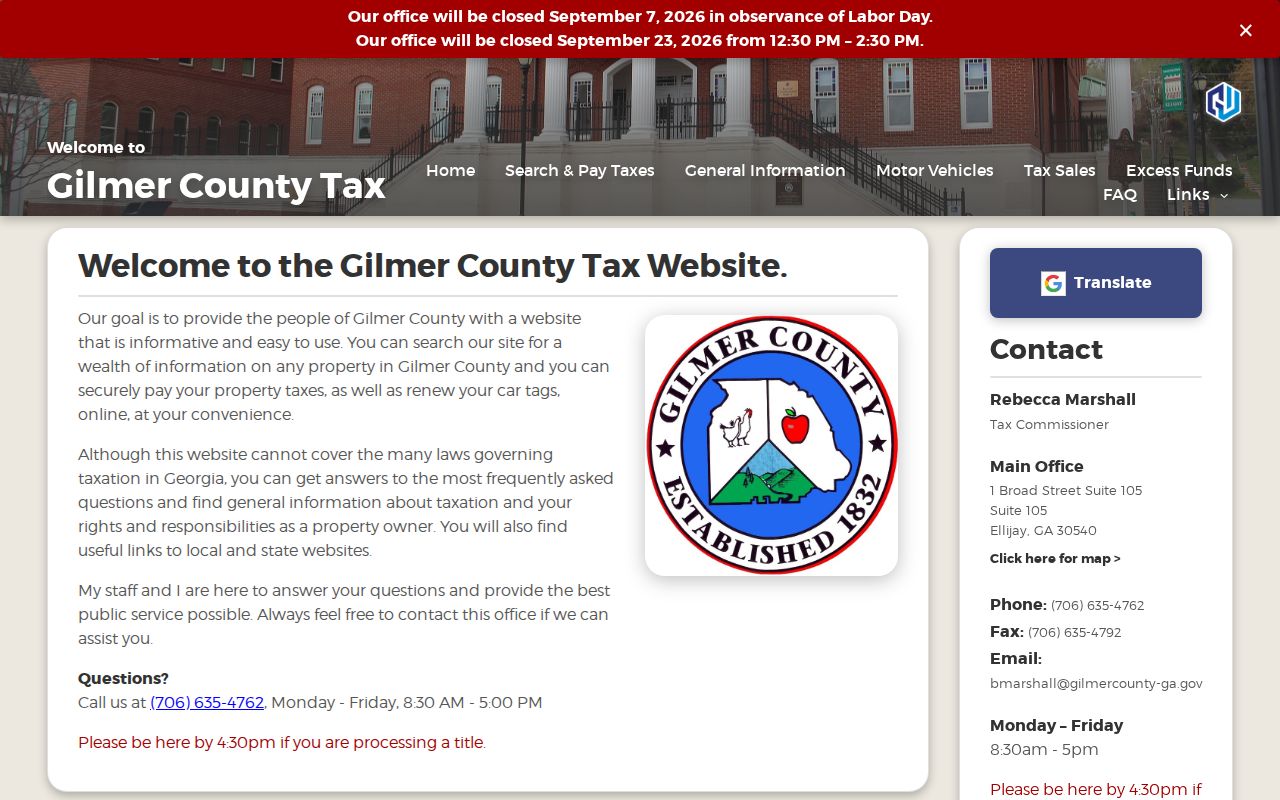
That portal view is only the front door. The opened account reveals the current year, balance, and payment detail you need for a real comparison.
Gilmer County Homestead Filing Has a 45-Day Test
The assessor's homestead instructions tie eligibility to owning and occupying the home on January 1. You can apply any time during the year. But filing within 45 days of the assessment-notice date matters. That is what makes the exemption count for that tax year. Once approved, homestead generally renews itself unless ownership, residence, or eligibility shifts. Gilmer County also publishes age-based, disabled-veteran, survivor, and other exemption routes. An affidavit path covers certain trust-held homes. Specialized property programs stand apart. Conservation Use Value Assessment runs on a ten-year covenant. It has its own land-use and acreage rules. Freeport covers specified business inventory, not ordinary residential land. Note: Eligibility rules can be narrow. So use the assessor's current form rather than copying a prior owner's tax treatment.
From Gilmer County Delinquency to a Tax Sale
Unpaid Gilmer County property tax follows a familiar arc. The arc runs bill, delinquency, fifa, levy, then tax-sale preparation. The local Tax Sales page publishes no searchable current list. So a careful buyer should call the Tax Commissioner for the latest material and verify each parcel in qPublic before bidding. The county's buyer-beware material tells researchers to search by owner, parcel, bill, or address. It says to inspect the Amount Due field. It also warns that a tax-sale buyer may not touch the property during Georgia's year-and-a-day redemption period. And the buyer gets no mobile home that carries a separate title or tax listing. Those are not footnotes. They change what a winning bid actually reaches. The county's official tax-sales page lays out the details:
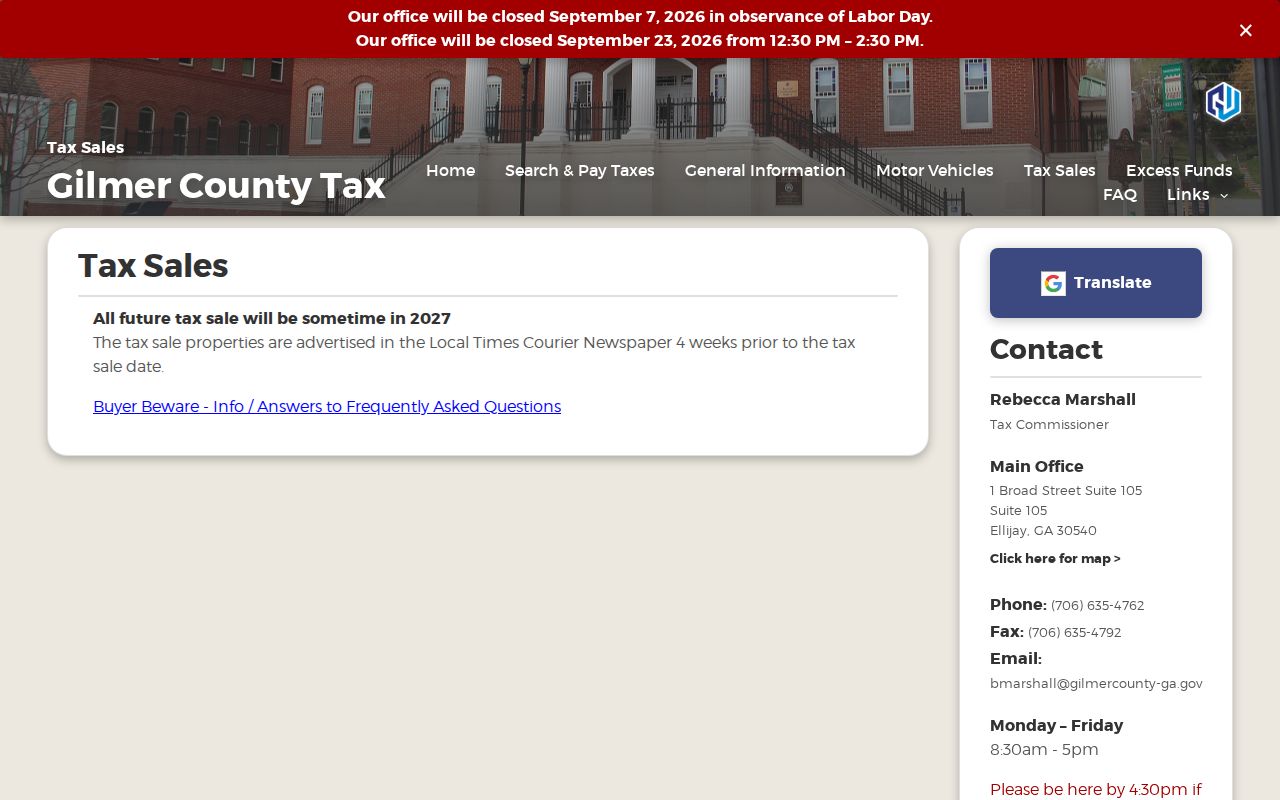
A dated page may hide the current sale list. Before relying on it, confirm the parcel and event with the Tax Commissioner.
Buyer beware. A tax sale is not a conventional land purchase; confirm the redemption status, deed record, separate mobile-home status, and current balance.
Contest a Gilmer County Property Tax Assessment
Every appeal begins with the annual notice of assessment. The tax bill that arrives later plays no part in starting the clock. Through the assessor's appeal instructions, an owner identifies the account by owner name, address, or parcel number. From there, submit the stated appeal form or a letter with the required facts. Filing by fax or email is not accepted. Use the online or mail route instead, and keep proof that the appeal arrived on time.
Before filing, compare the parcel card against the notice. Check the building description, acreage, digest class, exemptions, Current Value, Previous Value, and situs. Evidence should zero in on the claimed error. The Board of Tax Assessors reviews the filing first. Any later appeal steps follow the path the owner chose in the notice materials.
Appeal window. File with the Gilmer County Board of Tax Assessors within 45 days of the notice date; a tax-payment complaint does not preserve that deadline.
Offline Access to Gilmer County Property Tax Records
A portal may reject an address. It may simply fail to load. Fall back on the parcel number. Then call the office. The Tax Assessor sits at 1 Broad Street, Suite 106, Ellijay. The courthouse directory lists 706-276-2742. The Tax Commissioner works from the same courthouse complex. That office handles current bill and collection questions. Some records were never digitized. Others went missing over time. You can request these from the right custodian through the Gilmer County open-records process.
The county charges 10 cents per copy. A research fee kicks in after the first 15 minutes. Handling takes at least three business days. A request should name the parcel. Include the tax year and the document sought. State the preferred format as well.
For historic tax digests, two separate routes exist. The Georgia Archives Virtual Vault holds microfilm. FamilySearch offers a catalog route. The live tax portal is not a history archive. Start historic research from a known owner and year. Work through digest volumes rather than expecting a modern parcel ID to appear unchanged. The Georgia Archives organizes its tax-digest collection through microfilm finding aids. FamilySearch catalogs Georgia tax digests through 1900. These sources show a taxpayer and assessed property from an earlier era. They are not current Gilmer County property tax records. They cannot report a present balance.
For a recent account, keep a reproducible note. Record the search key, tax year, and access date. Add the assessed value, exemptions, and original bill. Note the amount due as well. A just-filed deed adds one wrinkle. The assessor working file and the tax bill can sit at different update stages. When the two systems have not yet synchronized, a direct office response is the best fallback.